> ## Documentation Index
> Fetch the complete documentation index at: https://docs.beam.cloud/llms.txt
> Use this file to discover all available pages before exploring further.
# Working in Jupyter Notebooks
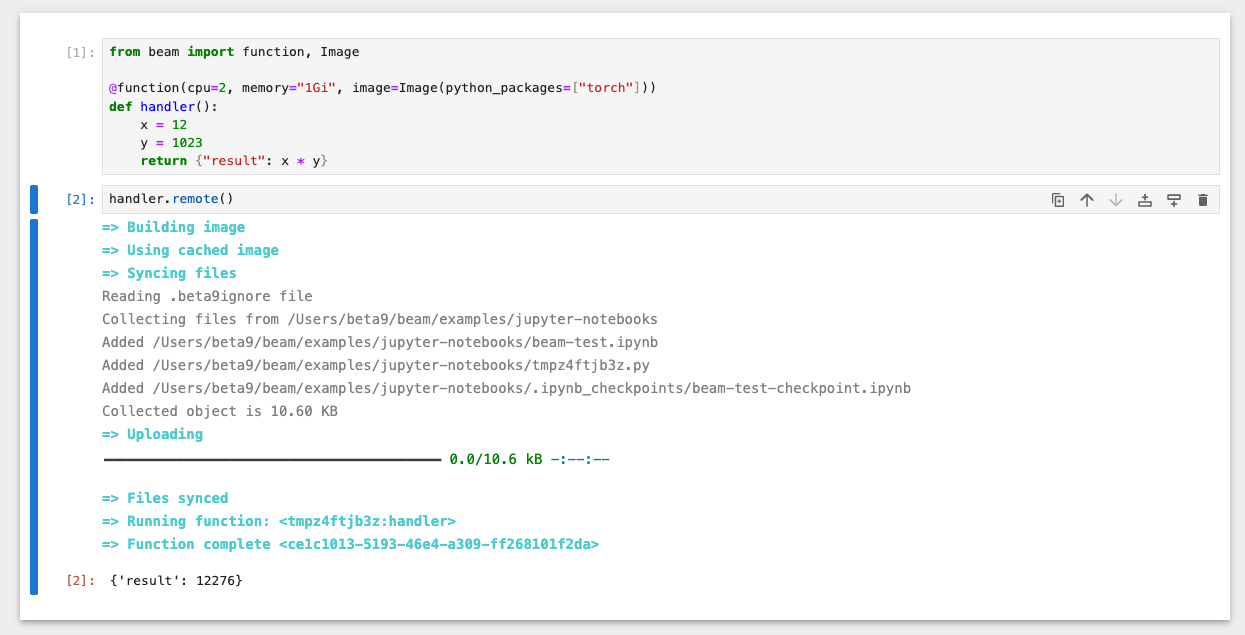
You can run Beam functions from Jupyter Notebook cells, which is useful for outsourcing heavy computation to Beam's serverless cloud.
Beam works in local notebooks and cloud notebooks like Google Colab.
Try out an example Jupyter Notebook
## Initial Setup
The first is installing `beam-client` and adding your Beam credentials to the notebook:
```
# Colab Setup: Install beam-client
!pip install beam-client
# Import the Beam client
import beam
# Add your Beam API key
!beam configure default --token [YOUR-BEAM-TOKEN]
!beam config select default
```
## Running Functions
Your local notebook server has access to the Beam credentials on your computer, so you can run Beam functions in the notebook cells like you normally would.
You can run GPU accelerated functions, mount storage volumes, and use the full-functionality of Beam from the notebook.
 ## Launching a Local Notebook Server
You can spin up a local Jupyter notebook server using the `jupyter` CLI.
**If you already have a local Jupyter environment, you can skip this step.**
If you don't have it installed yet, you can do it with `pip`:
```python theme={null}
pip3 install --upgrade pip && pip3 install jupyter
```
Launch the notebook server. The typically opens the server on `localhost:8888`.
```sh theme={null}
jupyter notebook
```
## Launching a Local Notebook Server
You can spin up a local Jupyter notebook server using the `jupyter` CLI.
**If you already have a local Jupyter environment, you can skip this step.**
If you don't have it installed yet, you can do it with `pip`:
```python theme={null}
pip3 install --upgrade pip && pip3 install jupyter
```
Launch the notebook server. The typically opens the server on `localhost:8888`.
```sh theme={null}
jupyter notebook
```